Spec-Driven Development: Building Software with Clarity Before Code
Spec-Driven Development is an approach where software implementation starts from a clear, structured specification rather than vague ideas, scattered tickets, or incomplete conversations.
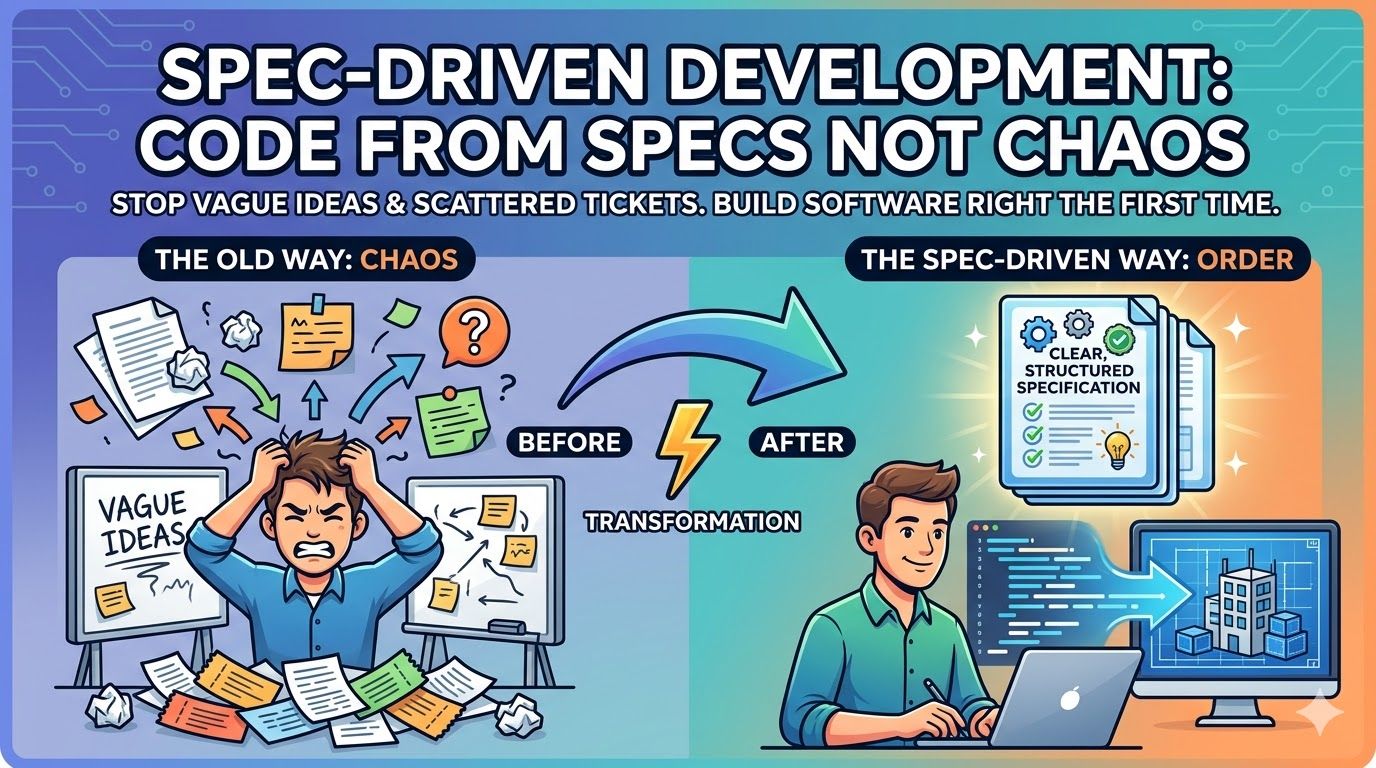
Spec-Driven Development: Building Software with Clarity Before Code
In modern software teams, one problem keeps showing up no matter how good the developers are: people start building before the problem is fully understood.
A feature gets discussed in Slack, a few ideas get mentioned in a meeting, someone writes a ticket, and engineering starts coding. A week later, product changes direction. Design finds a missing flow. QA discovers edge cases nobody considered. Engineering ends up rewriting work that should have been clear from the start.
This is exactly the kind of mess Spec-Driven Development is designed to solve.
What is Spec-Driven Development?
Spec-Driven Development is an approach where software implementation starts from a clear, structured specification rather than vague ideas, scattered tickets, or incomplete conversations.
Instead of jumping straight from “we need this feature” into code, the team first creates a spec that defines:
- the problem being solved
- the business goal
- user flows
- functional requirements
- edge cases
- constraints
- acceptance criteria
- technical considerations
- implementation tasks
The spec becomes the source of truth for everyone involved: product, design, engineering, QA, and increasingly, AI coding tools as well.
In short: think deeply first, build second.
Why traditional development often breaks down
A lot of teams believe they are already doing this because they have Jira tickets, product docs, or sprint planning. In reality, those artifacts are often fragmented and incomplete.
Common issues include:
- requirements spread across chats, calls, and tickets
- missing edge cases
- unclear user journeys
- no shared definition of done
- engineering making product decisions by guesswork
- QA discovering critical gaps too late
- AI coding tools generating code from weak prompts
When the input is messy, the output is messy too.
Code quality is often blamed on engineering execution, but many times the real problem starts much earlier: the team never had a clear spec.
The core idea: specifications as a first-class asset
Spec-Driven Development treats the specification as a first-class deliverable, not an afterthought.
A good spec is not a giant document written for bureaucracy. It is a practical tool that reduces ambiguity and aligns everyone before implementation starts.
A strong spec should answer questions like:
- What exactly are we building?
- Why does it matter?
- Who is it for?
- How should it behave?
- What should happen in normal cases?
- What should happen in edge cases?
- What are we explicitly not building?
- How will we know it is done?
If the team cannot answer those questions clearly, they are not ready to build.
What a good spec usually contains
The exact structure varies by team, but a solid spec often includes these sections:
1. Problem statement
What problem exists today? What pain point are we solving?
This keeps the team focused on outcomes, not just output.
2. Goals and non-goals
What are we trying to achieve, and what is out of scope?
This is critical for preventing scope creep.
3. Target users
Who will use this feature or system? Different users often have very different needs.
4. User flows
Step-by-step journeys of how users interact with the product.
This helps expose missing screens, decisions, and edge cases early.
5. Functional requirements
The concrete behaviors the system must support.
These should be specific enough that engineers and QA interpret them the same way.
6. Edge cases and exceptions
What happens when inputs are invalid, data is missing, integrations fail, or users take unexpected actions?
This is where many projects fail if the spec is too shallow.
7. Acceptance criteria
What conditions must be true for the work to be considered complete?
This gives product, engineering, and QA a shared definition of done.
8. Technical considerations
Architecture constraints, dependencies, security concerns, integration points, performance requirements, and operational considerations.
9. Task breakdown
A practical implementation plan that engineering can execute.
This bridges the gap between product thinking and delivery.
Why this matters even more in the age of AI
Spec-Driven Development is becoming more important, not less, because of AI-assisted coding.
Today, developers can generate large amounts of code with tools like ChatGPT, Claude, Cursor, Copilot, and other AI agents. That changes the bottleneck.
The bottleneck is no longer just writing code. The real bottleneck becomes giving the AI the right instructions.
If your prompt is vague, AI will generate vague or flawed solutions.
If your requirements are incomplete, AI will confidently build the wrong thing faster.
If your edge cases are missing, AI will miss them too.
This is why Spec-Driven Development pairs naturally with AI workflows.
A structured spec gives AI tools:
- clear product context
- precise requirements
- defined constraints
- expected flows
- known edge cases
- acceptance criteria
That leads to better code generation, fewer iterations, and less cleanup later.
AI makes execution faster. Specs make execution correct.
Benefits of Spec-Driven Development
Better alignment across teams
A clear spec reduces misunderstandings between product, design, engineering, and QA.
Fewer rewrites
Many reworks happen because the team discovers missing requirements too late. Specs catch those issues earlier.
Faster development overall
Writing a spec feels slower at first, but it usually saves much more time during implementation, testing, and review.
Better QA coverage
When acceptance criteria and edge cases are defined upfront, QA can test more effectively.
Easier onboarding
New engineers can understand the intent behind a feature without digging through old chats and tickets.
Stronger AI-assisted development
AI performs much better when it receives structured, comprehensive context rather than scattered notes.
Common misconceptions
“Specs slow us down”
Bad specs slow teams down. Good specs speed teams up.
The goal is not to create paperwork. The goal is to remove ambiguity before expensive work begins.
“Only big companies need specs”
Wrong. Small teams often need them even more because they have less time for rework and misalignment.
“We can figure it out during implementation”
Sometimes, yes. But “figuring it out later” is often just another way of saying “we’ll pay for ambiguity with engineering time.”
“Agile means no specs”
Agile does not mean vague. Agile means iterative, adaptive delivery. Clear specs and agile execution work very well together.
How to introduce Spec-Driven Development in a real team
You do not need a massive process overhaul.
Start simple:
- Pick one project or feature.
- Create a lightweight spec template.
- Require goals, flows, requirements, edge cases, and acceptance criteria before implementation starts.
- Review the spec with engineering and QA early.
- Break the approved spec into tasks.
- Use the spec as the source of truth during development.
Over time, the team will start seeing patterns in where confusion usually comes from. That feedback can improve the spec template itself.
What makes a spec actually useful
A useful spec is:
- clear instead of vague
- structured instead of scattered
- practical instead of academic
- detailed where it matters
- short where it can be
- written for execution, not for decoration
A spec should help someone build the right thing. If it cannot do that, it is not good enough.
Final thought
Spec-Driven Development is not about writing more documents.
It is about reducing ambiguity, improving alignment, and increasing the odds that what gets built is actually what was intended.
As software teams move faster and AI generates more of the implementation, the cost of unclear thinking goes up. Teams that can turn messy ideas into clear, structured specs will have a real advantage.
Because in the end, better code usually starts long before coding.
It starts with a better spec.